Fabric, semantic models, the sources the AI reads from
[ We build with you ]
We build inside
the Microsoft ecosystem.
Every AI project needs a different mix of skills: someone who knows the data, someone who knows governance, someone who builds agents. We put them together, inside the Microsoft environment you already have.
be·side








[ Where it starts ]
You already have the tools.
What you need is someone to build on them.
Microsoft 365 is running, the Copilot licences are handed out, and you have already done a pilot. Then it stayed there: Copilot answers on what it knows, not yet on what you know. The technology is not what is missing. What is missing are the people who can build on top of it, inside the perimeter you have built over the years.
An AI project never touches one thing only: it touches the data the AI answers from, the permissions on the tenant, the agents, the automations, the architecture, and the people who then have to use it every day. Six different trades, and their weight changes from project to project. No company has all of them in house. We put them together each time, around the request that comes in.
25+ Projects taken into production
100+ Specialists who work with us
6 Weeks to a working prototype. A pretotype in two.
The right person on the right problem.
Data · Governance · Agents · Automation · Architecture · Adoption
[ The tool ]
The software behind the team.
It is not a contact list. Every specialist who works with us is mapped by area of the suite, level and certifications. When a request comes in we translate it into skills: a semantic model that needs putting back in order calls for different people than an Azure environment that needs redesigning. We know straight away who is needed, and who is not.
For you it means no waiting. Instead of weeks spent working out who could take it on, you get a proposal with the team already formed and a single point of contact for the whole project.
[ The people ]
We put the team together around the request,
not around who happens to be free.
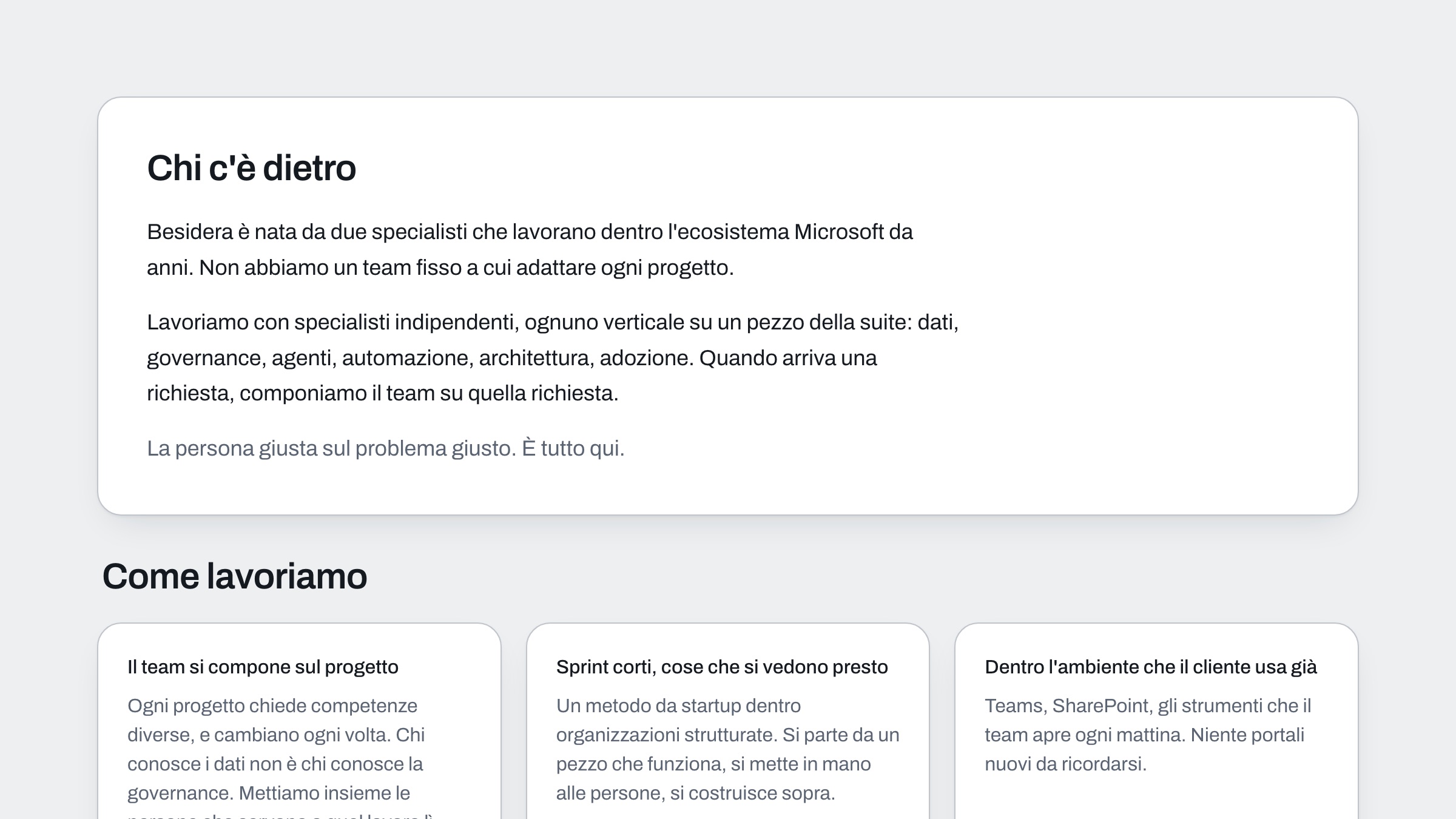
We do not have a fixed team that every project has to fit. We have a platform of our own, where every specialist is mapped by area of the suite, level and certifications. When a request comes in, the team is born in there: small, vertical, made of the right people for that problem.
The person who decides what the AI can see on the tenant is not the person who puts it in the hands of a department on Monday morning: two different trades, and on your project nobody arrives to learn. For you there is a single point of contact, even when several specialists are at work behind the scenes.
The platform, on three real requests
Permissions, perimeter, what Copilot is allowed to see
Copilot Studio, Foundry, orchestration
Power Platform, integrations, processes
Azure, identity, environments, cost
Role-based training, hands-on support
The team that comes out
One person builds it, one puts in order the manuals it will read, one checks the permissions before it answers anybody.
[ How we work ]
Build, measure, decide.
Inside your rules.
AI moves faster than budget cycles: a six-month analysis describes a landscape that has changed in the meantime. We work at the pace of people with few means and little time, within the timelines, the rules and the security your organisation requires.
01
We pick the piece
Half a dayOne process only, chosen together with the people who do it every day, because it stands on its own and because the result can be measured. Not a three-year plan: one piece.
02
We build it in fourteen days
One sprintAt the end of the sprint there is something people can open: an automation that runs on its own, a view of the data that used to be assembled by hand, an assistant that answers on real documents. Inside Teams or SharePoint, not in a test environment nobody visits.
03
We measure it on real use
Two weeksWho opens it, how often, where they get stuck, what they ask that we had not planned for. The numbers come from how people use it, not from a satisfaction survey.
04
We build on it, or we change course
The decisionThis is the point of the method. After a month the choice is informed by real data, and it has cost you a month, not the year budget.
[ What we do ]
Four ways of working together.
They are built on the question you actually ask, not on how we file our own skills. A project almost always touches more than one.
- 01
We want an agent that answers on our documents. Where do we start?
Agents and Copilot Studio Agents that answer on company documents inside Teams, with the permissions you already have and the source in every answer. - 02
If we switch Copilot on, who sees what?
Tenant governance and security Permissions get looked at before the rollout, not after the first incident. Where the data sits, who sees it, what stays inside the perimeter. - 03
The licences are there. How do we get people to open them?
Adoption and change management Buying Copilot is a half-hour decision. Getting it into Monday morning's work is a craft. - 04
We have to train our people on AI. What does that mean in practice?
Training and the AI Act The AI Act asks those who use AI systems to make sure people know what they are using. Training stops being optional.
[ What we build ]
Some of the things we build.
Projects differ by sector, size and starting point. These six are real projects, in different companies: the numbers are the real ones, the names stay out.
A thousand-page manual, one answer in 160 languages
Over 70% of the time spent training new starters, saved.
>70% saved on training new startersFrom 40 days to 19 minutes to pre-approve a mortgage
From application to pre-approval goes from 40 days to 19 minutes.
19 min from application to pre-approval, down from 40 daysThe patient asks, the agent books
60% more operational efficiency in 90 days, with shorter waits.
+60% operational efficiency in 90 daysFrom four hours to under one for a presentation
A presentation goes from four hours to under one, and the time freed goes back to billable work.
< 1 h per presentation, down from four hoursIt answers straight away, and knows when to hand over
Customers looked after while they ask, and commercial choices made on their real questions.
The phone answers, and the CRM fills itself in
Requests arrive already filled in, and people step in where they are really needed.
[ Adoption ]
The licences are there.
Almost nobody opens them.
This is where almost every AI project stops, and it is the part people talk about least. Buying Copilot for the whole company is a half-hour decision. Getting it into Monday morning is a trade, and it has a name: adoption and change management.
It is not a course. It is watching what an office actually does in a week, building the two or three uses that take work off their hands, and teaching those. Then standing beside people through the weeks that decide whether a thing becomes a habit or stays a tab opened once and never again.
Training by role
On the company’s real documents. People in sales do not use Copilot the way people writing quotes do.
Beside you in the first weeks
When it is decided whether the habit takes hold. That is where projects are lost.
Permissions checked first
The rollout starts when the perimeter is clear, not after the first incident report.
Real use as the measure
Who opens it, how much, where they stop. Month by month, not at the end of the project.
[ Inside your ecosystem ]
The foundations are already there.
That is where we build from.
An agent is only as useful as the documents it can reach. And those are already in your house. We build where people already work: inside Teams, inside SharePoint, inside the tools the team opens every morning.
The Microsoft environment your company has built over the years (identity, permissions, documents, processes) is not a limitation. It is the base, and it is also the guarantee: the AI inherits the permissions that are already there, so what a person cannot open they will not see either, even when they ask for it in words. The perimeter stays the one you approved.
[ Certifications ]
Whoever joins the team is certified
on the area they touch.
Certification is one of the filters we use to put the team together. It is not a badge collection: it is the reason why whoever secures your tenant, or builds what runs on top of it, has done it before.
Microsoft AI Product Manager Professional Certificate · 5 courses · December 2025 ID 4YN4QM6KX1HL
Enterprise Product Management Fundamentals Microsoft · December 2023
[ Let's talk ]
Tell us what you want to build.
We take care of the team. You do not need a specification: just tell us what you want to achieve, whether that is a process that should run on its own or an answer someone looks up by hand today, and which environment you work in.
Let's talk about your project
A thirty minute call. If the project is not for us, we'll say so.